

Florida Property Taxes: What Home Buyers Should Know
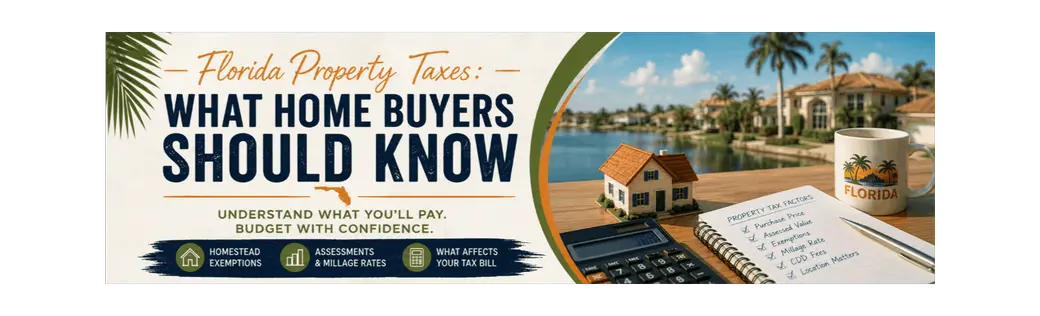
Florida Property Taxes: What Home Buyers Should Know
You're looking at a house in Florida and trying to figure out what the monthly payment will be.
Mortgage? Got it.
Insurance? Working on it.
Property taxes?
Well, the current owner paid $2,800 last year, so we'll just use that.
Not so fast.
One of the easiest mistakes a Florida homebuyer can make is assuming the seller's current property tax bill is a good estimate of what they'll pay after buying the house.
Sometimes it's close.
Sometimes it's not even in the same neighborhood.
Here's why.
Why Can Property Taxes Change After You Buy a Home?
Florida property taxes are based partly on the property's assessed value, and the current owner's assessed value may be very different from the price you're paying.
The owner may have purchased the property years ago. If it's their primary residence, they may also have a homestead exemption and years of Save Our Homes assessment limitations affecting their taxable value.
When the property changes ownership, those protections don't simply transfer to you.
The property can be reassessed, and your future tax bill may look considerably different from the seller's current one.
That's why I don't like estimating a buyer's future taxes by simply copying last year's tax bill.
What Is the Florida Homestead Exemption?
If the home will be your permanent Florida residence and you meet the requirements, you may be able to apply for Florida's homestead exemption.
The exemption can reduce the taxable value used for certain property taxes.
Homestead also comes with another important benefit: the Save Our Homes assessment limitation.
Once established, Save Our Homes limits how much the assessed value of a homesteaded property can increase from year to year.
That's one reason someone who has owned a Florida home for 20 years may have a surprisingly low tax bill compared with the home's current value.
They didn't find a secret tax coupon.
They've just owned the house for a while.
What Happens to the Seller's Homestead When the Home Is Sold?
The seller's homestead exemption doesn't become yours.
If you qualify, you'll apply for your own exemption after becoming the owner and establishing the property as your permanent residence.
The property's assessed value can also reset following a change in ownership.
That's the part buyers sometimes miss.
You might buy a home from someone who has lived there for decades and discover that your future property taxes are considerably higher than theirs were.
Nothing necessarily went wrong.
You're just starting from a different assessed value.
Are Property Taxes Based on the Purchase Price?
Not exactly.
The purchase price is relevant, but Florida property taxes aren't calculated by taking the sales price and multiplying it by one statewide tax rate.
The property's assessed value, exemptions and local tax rates all play a part.
Taxes can also vary by location.
Two similarly priced homes a few miles apart can have different tax bills because they're in different taxing jurisdictions.
What's a Millage Rate?
You'll probably run across the word millage while researching Florida property taxes.
It sounds more complicated than it is.
One mill represents $1 of tax for every $1,000 of taxable value.
Different local taxing authorities contribute to the total rate for a property.
You don't need to become a millage-rate expert to buy a house.
You just need to know that the rate can vary by location and the home's taxable value matters too.
What About CDDs and Other Assessments?
Some charges on a Florida property tax bill aren't based directly on the home's value.
You may see non-ad valorem assessments for certain local services or improvements.
Some communities also have a Community Development District, better known as a CDD. CDD assessments are often collected on the property tax bill.
This matters when comparing homes.
Two houses with similar prices and HOA fees can have different annual costs once taxes and CDD assessments enter the picture.
Look at the whole bill.
How Should You Estimate Future Property Taxes?
Don't rely solely on what the seller currently pays.
Instead, consider:
-
Purchase price
-
Current assessed and taxable values
-
Homestead and other applicable exemptions
-
Local tax rates
-
Non-ad valorem assessments
-
CDD assessments, if applicable
County property appraiser websites can be useful for researching a home's assessment history and, in some counties, estimating future taxes.
The goal isn't to predict your future tax bill down to the penny.
It's to avoid a nasty surprise.
Why Can Your Mortgage Payment Go Up?
If your mortgage has an escrow account, part of your payment goes toward property taxes and homeowners insurance.
If either of those expenses increases, your monthly escrow payment may increase too.
That's how someone can have a fixed-rate mortgage and still see their total monthly payment go up.
The principal and interest may be fixed.
Taxes and insurance aren't.
That's worth knowing before the first escrow analysis shows up in your mailbox.
What Is Homestead Portability?
If you already own a homesteaded property in Florida and are moving to another Florida home, you may be eligible to transfer some of your accumulated Save Our Homes benefit.
That's commonly called portability.
There are eligibility requirements and deadlines, so this isn't something I'd try to calculate from a real estate listing.
Check with the property appraiser in the county where you're buying to see how it applies to your situation.
Don't Forget to Apply for Homestead
If the property will be your permanent Florida residence and you qualify, put the homestead application on your post-closing checklist.
You generally apply through the property appraiser's office in the county where the home is located.
Don't buy the house and then forget about it for three years.
Future you may appreciate that.
Buying Your First Home in Florida?
Property taxes are only one piece of figuring out what a home will actually cost each month.
There's also homeowners insurance, financing, inspections, closing costs and the occasional expense nobody mentioned while you were admiring the kitchen.
→ First-Time Homebuyer Guide for Central Florida
Buying a Home in Central Florida?
When we're comparing homes, I like to look beyond the asking price.
A house with a lower price can still cost more each month once you factor in property taxes, homeowners insurance, HOA fees and CDD assessments.
And the seller's current tax bill?
Useful information.
Just don't assume it'll be yours.
If you're looking at homes in Winter Springs, Oviedo, Seminole County or the surrounding Central Florida area, we're happy to help you look at the bigger picture before deciding what fits your budget.
→ Living in Winter Springs, FL: A Local Real Estate Guide
The goal isn't just figuring out whether you can buy the house.
It's figuring out what it'll actually cost to own it.
Twinhaven Team
LPT Realty
Roger & Aimee Brown
Serving Winter Springs, Seminole County and surrounding Central Florida communities.
689-245-3520
roger@twinhaventeam.com
Categories
Recent Posts











Real estate is personal. We’re here to provide local insight, clear communication, and guidance every step of the way.
GET MORE INFORMATION