

How Roof Age Can Affect Homeowners Insurance in Florida
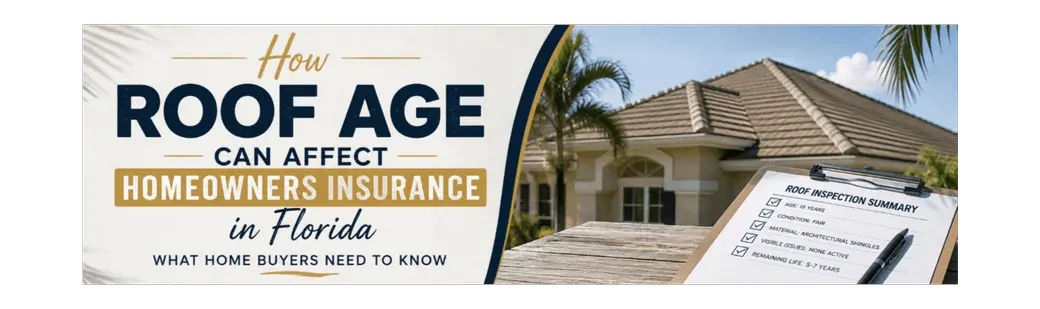
How Roof Age Can Affect Homeowners Insurance in Florida
You're looking at a house in Florida. The roof looks fine. No leaks. No missing shingles. Nothing growing out of it.
Then you start getting homeowners insurance quotes and suddenly everyone wants to know:
How old is the roof?
Welcome to buying a home in Florida.
Roof age can have a big effect on your insurance options, and it's something buyers should pay attention to before getting too far into a purchase.
A perfectly decent-looking roof can still create an insurance issue simply because of its age.
Here's what you need to know.
Why Do Florida Insurance Companies Care About Roof Age?
Roofs are expensive.
They're also the part of your house standing between everything you own and Florida's combination of sun, rain, wind and the occasional hurricane.
Insurance companies look at the age, material and condition of a roof when deciding whether they'll insure a property and how they'll handle roof coverage.
An older roof doesn't automatically mean a home can't be insured.
It does mean you should start asking questions.
How Old Is Too Old for a Roof in Florida?
This is where people want a nice, simple answer.
Unfortunately, there isn't one.
Insurance companies have their own underwriting requirements, and those requirements can change. Roof material, condition, remaining useful life and documentation may all matter.
A 15-year-old roof isn't automatically a problem.
A 20-year-old roof isn't automatically uninsurable.
And a newer roof isn't automatically a good roof.
That's why I wouldn't use a rule like:
“If the roof is more than ___ years old, don't buy the house.”
Find out exactly what you're dealing with and start getting insurance quotes early.
How Do You Find Out How Old a Roof Is?
Sometimes it's easy.
The seller knows when it was replaced and has the paperwork.
Other times, figuring it out takes a little detective work.
Possible sources include:
-
Seller disclosures
-
Roofing permits
-
Receipts or contracts
-
Previous inspection reports
-
County or city permit records
If someone tells you, “I think the roof is about ten years old,” that's useful.
Documentation is better.
Does Roof Material Matter?
Yes.
Florida homes commonly have shingle, tile, metal and flat or low-slope roofing systems.
Different materials have different expected lifespans, but age alone doesn't tell you the condition of a roof. Installation quality, maintenance, storm damage and exposure matter too.
And here's an important distinction:
A roof's expected lifespan and the age an insurance company is comfortable with aren't necessarily the same thing.
What Will the Home Inspector Look For?
During a home inspection, the inspector will look at the visible condition of the roof for things like damage, deterioration, leaks, flashing problems and previous repairs.
If something looks questionable, the inspector may recommend having a licensed roofer take a closer look.
That's not automatically bad news.
Sometimes the answer is a repair. Sometimes it's a bigger conversation.
The important part is finding out while you still have options.
→ What to Expect During a Home Inspection in Florida
What Does the Roof Have to Do With a 4-Point Inspection?
Quite a bit.
The roof is one of the four systems documented on a 4-point inspection, along with electrical, plumbing and HVAC.
The report typically includes information about the roof's age, material, condition and remaining useful life. Insurance companies can use that information when deciding whether they'll insure the property.
We've covered the rest separately.
→ What Is a 4-Point Inspection in Florida?
What About Wind Mitigation?
That's a different inspection.
Wind mitigation looks at construction features that can help the home resist wind damage and may qualify the property for insurance discounts.
→ What Is a Wind Mitigation Inspection in Florida?
What If the Roof Is Near the End of Its Life?
Don't immediately write off the house.
First, find out what you're actually dealing with.
How old is the roof? What condition is it in? Are there leaks or damage? What does the inspector say? Can you get insurance, and what will it cost?
If further evaluation is needed, get a roofer involved.
Once you have the answers, you can make a much better decision.
The roof might need a repair. It might need replacement soon. It could become part of the negotiation.
Or it may turn out to be far less dramatic than you thought.
Can a Roof Issue Be Negotiated?
Potentially.
Depending on the contract and circumstances, an older or damaged roof may become part of the conversation between buyer and seller.
There isn't one solution that works for every transaction.
First we figure out the actual problem.
Then we figure out the options.
Get Insurance Quotes Early
Don't wait until two days before closing to start shopping for homeowners insurance.
Once you're under contract, get started early enough that you have time to find out whether the roof—or anything else about the property—is creating an insurance problem.
A house can fit your budget based on the mortgage payment and suddenly look a lot different when you see the insurance premium.
You want to know that before you own it.
Selling a Florida Home With an Older Roof?
Roof age matters on the selling side too.
If the roof is older, gather whatever documentation you have. Permits, receipts, warranties and previous inspection information can answer questions buyers and insurance agents are likely to ask.
Should you automatically replace an older roof before listing?
Not necessarily.
Depending on its condition and the market, replacing it might make sense—or you might spend a lot of money you didn't need to spend.
That's a conversation worth having before ordering a roof.
Buying Your First Home?
Roof age is just one of several Florida-specific issues you'll encounter.
Insurance, inspections, appraisal, financing and closing all start happening pretty quickly once your offer is accepted.
→ First-Time Homebuyer Guide for Central Florida
Buying a Home in Central Florida?
An older roof doesn't automatically make a house a bad house.
And a newer roof doesn't automatically make it a good one.
What matters is knowing what you're buying, understanding how the roof affects your insurance options and factoring upcoming costs into your decision.
That's why we start asking about roofs while we're looking at homes—not when everybody is already packing for closing.
If you're buying or selling in Winter Springs, Oviedo, Seminole County or the surrounding Central Florida area, we're happy to help you figure out what questions to ask and who needs to answer them.
Because “the roof looks okay to me” probably shouldn't be the entire roofing strategy.
Twinhaven Team
LPT Realty
Roger & Aimee Brown
Serving Winter Springs, Seminole County and surrounding Central Florida communities.
689-245-3520
roger@twinhaventeam.com
Categories
Recent Posts







Real estate is personal. We’re here to provide local insight, clear communication, and guidance every step of the way.
GET MORE INFORMATION